Research
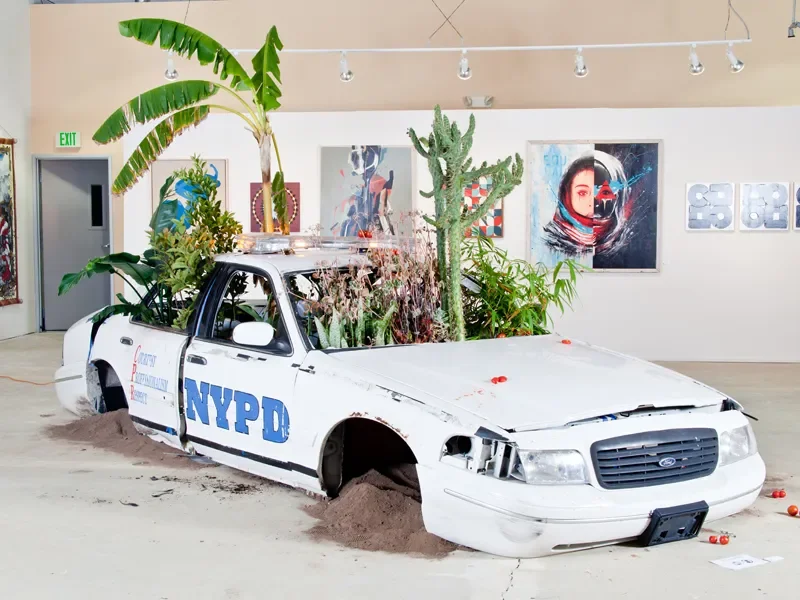
Jordan Weber, American Dreamers (Phase 2), 2015. Cop car, Ferguson earth, fruit plants, cactus, tomatoes. Dimensions varied. Photo credit: Manifest Justice.
This work embodies the creative transformation of carceral materiality into new forms of life, care, and possibility—questions central to my research on policing, space, and decarceration.
Research
My research examines how policing, punishment, housing, and surveillance shape everyday life—and how communities build alternatives grounded in care, repair, and collective well-being. I bring together Black Studies, abolitionist thought, Black Geographies, and urban sociology to analyze the spatial and institutional organization of safety and to imagine forms of collective life beyond carceral systems.
Across books, articles, and public scholarship, I trace how carceral systems are embedded not only in police institutions and prisons, but also in housing policy, urban governance, and the built environment. At the same time, my work centers the knowledge, strategies, and experiments through which Black communities contest state violence and build life beyond punishment.
The Decarceral Futures Project
The Decarceral Futures Project brings together my research, writing, organizing, and public scholarship developed over the past several years. The project examines how policing, punishment, surveillance, and spatial governance shape everyday life, and how communities living under these conditions imagine and build alternatives grounded in care, repair, and collective responsibility.
Across my work, decarceral futures names both a set of shared questions and a method of inquiry. It connects my research on public housing, policing, and carceral institutions by treating safety not as something enforced through control, but as something produced—or undermined—through material conditions, political decisions, and social relations. The project focuses on how people practice decarceration in everyday struggles over housing, public space, institutional power, and collective survival.
Book Projects
Brick Dreams: The Unfinished Project of Public Housing
(Princeton University Press, forthcoming)
Brick Dreams centers a high-rise public housing development in Brooklyn, New York. Drawing on ethnographic research, the book explores how residents navigate safety, policing, building conditions, and cycles of poverty amid decades of state divestment.
By foregrounding residents’ everyday strategies of care, survival, and collective life, the project shows how housing is not simply a backdrop to inequality but a central site where questions of safety, governance, and possibility are negotiated. In doing so, Brick Dreams offers new perspectives on race, poverty, and the unfinished promises of public housing in the United States.
Beyond Policing
(Legacy Lit | Hachette, 2024)
Beyond Policing examines the historical expansion of policing as the dominant response to social harm and demonstrates how reform-based approaches consistently reproduce violence. The book argues for safety as something built through investment, community infrastructure, and non-carceral responses to crisis, drawing on data, community-based models, and lived experience.
Articles and Ongoing Research
In addition to book-length projects, my research examines the spatial logics of policing and anti-Black racism, the afterlives of carceral institutions, and the strategies communities use to contest state violence and reimagine safety. This work includes analyses of police spending, university policing, and the reuse of former carceral spaces, with particular attention to how art, design, and spatial transformation become sites of abolitionist practice.
See here for an updated Curriculum Vitae
Selected Publications:
McHarris, Philip. 2020. “The Spillover Effects of Police Violence.” Social Psychological Review.